INTRODUCTION AND WHAT YOU ARE MAKING
A sourdough blueberry croissant is a laminated pastry made from naturally fermented dough layered with butter and filled with a thick blueberry compote. Unlike regular croissants that use commercial yeast, this version relies entirely on wild yeast and bacteria from a sourdough starter. That means fermentation is slower, flavor is more complex, and timing is less predictable.
You are essentially managing three systems at once:
Fermentation system (sourdough starter activity)
Lamination system (butter and dough layering)
Filling system (blueberry moisture and stability)
If even one system is out of balance, the final croissant will suffer. This is why croissant making is considered advanced pastry work.
DAY 1: STARTER PREPARATION AND DOUGH FOUNDATION
The sourdough starter is the engine of the entire recipe. It must be at peak activity, meaning it should have recently doubled or tripled in size after feeding, appear full of bubbles, and have a domed top that is just starting to flatten.
If your starter is sluggish, croissants will turn out dense and under-risen because there is no backup yeast.
Once the starter is ready, you begin mixing the dough.
You combine strong bread flour, cold milk, sugar, salt, and active starter. Each ingredient has a specific role:
Bread flour provides gluten strength for structure
Milk tenderizes crumb and adds softness
Sugar feeds yeast and improves browning
Salt strengthens gluten and controls fermentation
Starter provides fermentation and acidity
At first mixing, the dough will feel uneven and rough. Some parts will look hydrated while others look dry. This is normal because flour hydration is not immediate. Milk takes time to fully penetrate starch granules.
Instead of rushing into kneading, you allow a rest period. This rest is critical because it allows gluten proteins (glutenin and gliadin) to begin bonding naturally. Even without mechanical kneading, structure starts forming.
After resting, kneading begins.
KNEADING STAGE AND GLUTEN DEVELOPMENT
Kneading croissant dough is not about brute force. It is about alignment. You are organizing gluten strands into a network that can stretch without tearing.
At first, the dough will resist and feel sticky. As you continue kneading, it becomes smoother and more elastic. You are looking for the windowpane effect: when a small piece of dough can be stretched thin enough to let light pass through without tearing.
Once gluten is developed, softened butter is added into the dough.
This is a critical distinction: this butter is not for layers. It is inside the dough to create tenderness.
At first, the dough may break apart or feel greasy. This is because fat interferes with gluten bonding temporarily. Continued kneading re-emulsifies everything into a smooth dough.
Now the dough is ready for fermentation.
BULK FERMENTATION (FIRST RISE)
The dough is placed in a covered container at room temperature. Unlike bread, croissant dough does not aim for full doubling.
You are looking for:
About 30 to 50 percent increase in volume
Slight aeration and softness
Visible bubbles under the surface
A slight jiggle when shaken
This fermentation is slow because butter and sugar inhibit yeast activity.
During the first few hours, you perform stretch and folds. This strengthens gluten without tearing it. Each fold aligns structure and improves elasticity.
After several cycles, the dough becomes smooth and extensible.
Then it is refrigerated overnight.
This cold fermentation is essential because:
It slows yeast activity
Develops flavor compounds
Solidifies butter inside dough
Makes lamination easier
DAY 2: BUTTER BLOCK AND LAMINATION SCIENCE
Now you prepare the butter block, which is the heart of croissant structure.
Butter must be plastic, meaning flexible but not melting. Ideal temperature is around 14–18°C depending on butter type.
If butter is too cold, it will fracture into pieces during rolling. If too warm, it will leak and absorb into dough.
You shape butter into a flat rectangle using parchment paper and rolling pin. Uniform thickness is critical because uneven butter leads to uneven layers.
Now you encase butter in dough.
This creates a sealed package called a détrempe (dough) and beurre (butter block) envelope.
LAMINATION PROCESS (LAYER CREATION)
Lamination is the controlled layering of dough and fat through rolling and folding.
Each fold multiplies layers exponentially:
First fold creates 3 layers
Second fold creates 9 layers
Third fold creates 27 layers
Each butter layer later splits into multiple sublayers during baking, producing hundreds of flaky sheets
You roll the dough carefully into a long rectangle.
Pressure control is everything:
Too hard → butter breaks and leaks
Too soft → butter melts into dough
Uneven → irregular crumb structure
After rolling, you perform a letter fold.
Then you chill the dough.
This chilling is not optional. It resets butter firmness and relaxes gluten. Without rest, gluten will resist rolling and tear layers.
This cycle repeats two more times.
Between folds, dough must remain cold but not frozen.
After final fold, dough rests overnight.
At this point, you have true laminated croissant dough.
DAY 2 OR 3: BLUEBERRY FILLING ENGINEERING
Blueberry filling is not just flavor. It is a moisture-controlled system.
If too wet, it will destroy layers. If too dry, it will taste dull.
You cook blueberries slowly with sugar and lemon juice.
As heat increases:
Cell walls break down
Natural pectin is released
Water evaporates
Mixture thickens
You continue cooking until it reaches a jam-like consistency.
To stabilize further, starch is added.
The goal texture is:
Thick like jam
Glossy surface
Holds shape on spoon
Does not run when cooled
Cooling is critical. Warm filling melts butter layers instantly.
DAY 3: SHAPING CROISSANTS
Now you roll laminated dough into a large sheet.
Thickness should be even across entire surface. Uneven thickness causes uneven rise.
Edges are trimmed to expose clean layers.
Then you cut long triangles.
Each triangle is slightly stretched to improve roll length. This helps create more spiral layers.
At the base, blueberry filling is added carefully.
Overfilling is one of the most common failures. It causes bursting and leaking during baking.
Rolling must be controlled:
Start at base
Roll evenly toward tip
Do not squeeze too tightly
Allow slight looseness for expansion
Too tight = dense center
Too loose = weak structure
Final shape should be symmetrical and stable.
PROOFING STAGE (CRITICAL FERMENTATION CONTROL)
Proofing sourdough croissants is slow and delicate.
Temperature ideally stays warm but not hot.
You are looking for:
Puffed appearance
Jiggly texture when tray is shaken
Layers slightly visible
Soft but not collapsing structure
Under-proofed croissants explode in oven due to trapped gases expanding too quickly.
Over-proofed croissants collapse because gluten weakens and butter separates.
This is one of the hardest stages to judge visually.
DAY 3: BAKING SCIENCE
Before baking, croissants are brushed with egg wash.
This provides:
Golden color through Maillard reaction
Shiny surface
Slight crust sealing
Oven must be fully preheated.
Baking happens in two phases:
High heat phase creates rapid steam expansion
Lower heat phase cooks interior fully
Inside the oven:
Butter melts
Water turns to steam
Steam expands trapped layers
Gluten sets structure
Sugar caramelizes exterior
This creates the signature honeycomb interior.
FINAL COOLING AND TEXTURE SETTING
Cooling is not optional waiting time. It is structural stabilization.
Inside the croissant:
Steam slowly escapes
Layers set into final shape
Butter redistributes slightly
Crust becomes crisp
Cutting too early compresses layers and releases steam prematurely.
EXPECTED FINAL RESULT
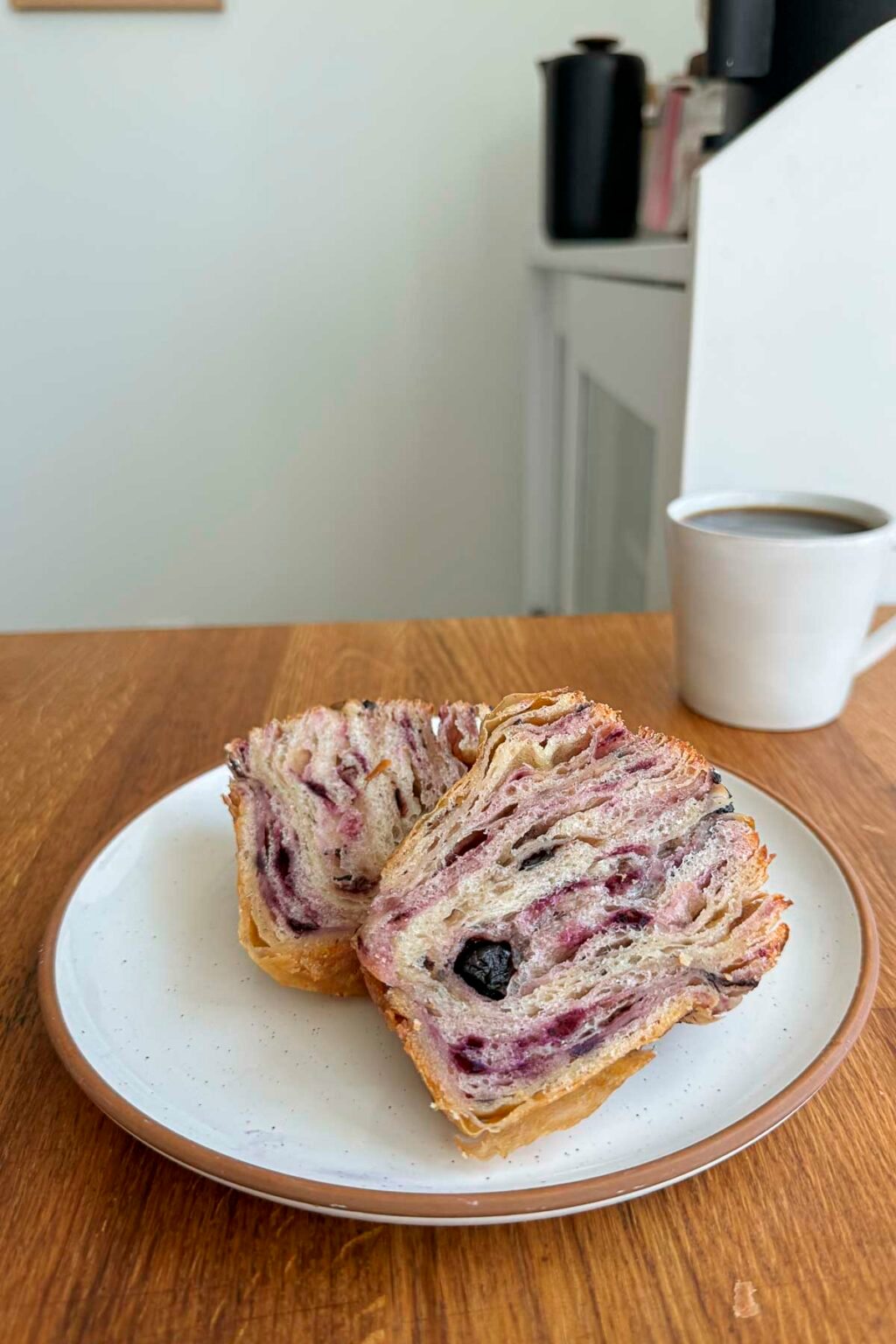
A perfect sourdough blueberry croissant should have:
Exterior that is golden, crisp, and slightly crackly
Interior with visible airy honeycomb layers
Butter-rich aroma
Balanced tang from sourdough
Sweet, slightly tart blueberry pockets
COMMON FAILURE ANALYSIS
Butter leakage → temperature too warm during lamination
No layers → butter absorbed into dough
Dense crumb → weak starter or under-proofing
Flat croissants → over-proofing or weak gluten
Soggy center → watery filling or underbaking
ADVANCED PROFESSIONAL NOTES
Professional bakeries control:
Dough temperature at all times
Room humidity
Butter plasticity zones
Precise fermentation timing
Home bakers compensate by:
Frequent chilling
Slower rolling
Visual judgment of proofing
Patience over speed
Croissant making is not just baking. It is temperature management, fermentation control, and fat layering disciplin