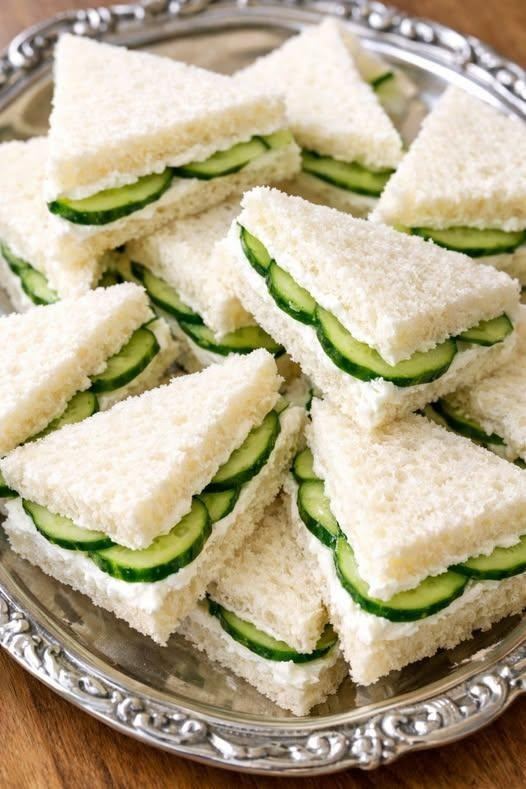
Cucumber tea sandwiches are strongly associated with the tradition of afternoon tea, which originated in England during the 19th century. Over time, this custom traveled to the American South, where it became a symbol of hospitality, refinement, and social gatherings such as garden parties, church luncheons, bridal showers, and summer events.
In Southern culture, food is often tied to presentation and etiquette. Tea sandwiches are expected to be:
- Neatly trimmed
- Soft and delicate
- Mild in flavor
- Easy to eat in a few bites
Cucumber sandwiches in particular are valued for their cooling quality, especially in warm climates.
2. Understanding the Key Components
Before preparing the recipe, it is important to understand the role of each component:
Cucumbers
Cucumbers are the star ingredient. Their role is to provide:
- Freshness
- Crunch (if not over-softened)
- Mild vegetal flavor
- High water content (which must be controlled)
Cream Cheese Spread
The spread acts as:
- A flavor base
- A moisture barrier (partially)
- A binding element that holds cucumber slices in place
Bread
Bread is not just a container—it defines the texture. It should be:
- Soft
- Fine-crumbed
- Thinly sliced
- Neutral in flavor
Butter Layer
Butter serves a technical function:
- Prevents sogginess by creating a fat barrier
- Adds richness
3. Ingredient
Choosing the Right Cucumbers
There are several types of cucumbers you can use:
- English cucumbers (recommended)
- Thin skin
- Minimal seeds
- Less bitter
- More uniform slices
- Persian cucumbers
- Smaller but similar to English cucumbers
- Slightly sweeter
- Regular garden cucumbers
- Thicker skin (may need peeling)
- Larger seeds (may need removal)
Avoid overly mature cucumbers as they:
- Contain excess water
- Have tougher seeds
- Can taste slightly bitter
Choosing the Cream Cheese
- Use full-fat cream cheese for best texture and flavor.
- It must be softened at room temperature to ensure smooth mixing.
- Low-fat versions tend to be watery and less stable.
Choosing Herbs
Fresh herbs are strongly preferred:
- Dill provides classic flavor pairing with cucumber.
- Chives add mild onion notes without overpowering.
Optional herbs:
- Parsley (for freshness)
- Tarragon (for a subtle licorice note)
Choosing Bread
The ideal bread should:
- Be very soft
- Have a tight crumb (few holes)
- Be easy to cut cleanly
Common choices:
- White sandwich bread (most traditional)
- Pullman loaf (very uniform and square)
- Whole wheat (less traditional but acceptable)
Bread must be fresh but not overly moist.
4. Ingredient List (Expanded)
Filling
- 2 large cucumbers
- 8 ounces cream cheese
- 2 tablespoons mayonnaise (optional)
- 1 tablespoon lemon juice
- 1 teaspoon lemon zest
- 1 to 2 tablespoons fresh dill
- 1 tablespoon fresh chives
- Salt
- Black pepper
Bread and Assembly
- 1 loaf white sandwich bread
- 4 to 6 tablespoons unsalted butter
5. Preparation Process
Step 1: Washing and Peeling
- Rinse cucumbers under cold water.
- Dry thoroughly with a clean towel.
- Peeling is optional:
- Peel completely for a refined look.
- Leave partial strips for decorative effect.
Step 2: Slicing Cucumbers
Uniform slicing is critical.
Options:
- Knife: requires skill for thin slices
- Mandoline: ensures consistency
Target thickness:
- Approximately 1 to 2 millimeters
- Thin enough to bend slightly without breaking
Step 3: Moisture Removal Process
This is one of the most important technical steps.
- Lay slices flat on paper towels.
- Lightly sprinkle salt over them.
- Let sit for 20–30 minutes.
What happens:
- Salt draws water out through osmosis.
- This prevents soggy sandwiches later.
After resting:
- Blot slices thoroughly with paper towels.
- Do not rinse unless overly salted.
Step 4: Making the Spread
- Place softened cream cheese in a bowl.
- Stir until smooth.
- Add mayonnaise if using.
- Mix in lemon juice and zest.
- Add herbs.
- Season with salt and pepper.
Texture goal:
- Smooth
- Spreadable
- Not runny
Flavor goal:
- Slightly tangy
- Fresh and herbaceous
Step 5: Bread Preparation
- Lay slices flat.
- Remove crusts carefully:
- Use a sharp knife
- Keep edges straight
- Butter each slice lightly:
- Apply edge-to-edge coverage
- Do not over-apply
Step 6: Assembly Technique
- Spread cream cheese evenly.
- Arrange cucumber slices in a single layer:
- Slight overlap
- Avoid stacking too thickly
- Place top slice:
- Cream cheese side down
- Press gently:
- Do not compress too much
Step 7: Cutting Techniques
Use a very sharp knife.
Common cuts:
- Finger sandwiches (rectangular strips)
- Triangles (diagonal cut)
- Small squares
Wipe knife between cuts for clean edges.
6. Chilling and Storage
After assembly:
- Cover with damp paper towel
- Wrap with plastic
Refrigerate for 30–60 minutes.
This allows:
- Flavors to meld
- Structure to stabilize
Do not store too long (maximum 6–8 hours).
7. Presentation Principles
Southern tea sandwiches emphasize elegance.
Serving tips:
- Use a white or pastel platter
- Arrange symmetrically
- Garnish lightly (herbs or edible flowers)
Avoid overcrowding.
8. Advanced Techniques
Moisture Control Strategy
- Salt cucumbers
- Use butter barrier
- Avoid overfilling
Texture Balance
- Bread: soft
- Filling: creamy
- Cucumbers: slightly crisp
9. Variations (Extended)
Classic Variations
- Add thinly sliced radishes
- Use herbed butter instead of plain butter
Rich Variations
- Add smoked salmon
- Add a thin layer of egg salad
Flavor Twists
- Add garlic powder
- Use flavored cream cheese
10. Common Mistakes
- Skipping cucumber drying
- Using thick bread
- Overfilling
- Cutting with dull knife
- Making too far in advance
11. Serving Context
Traditionally served with:
- Hot tea
- Light desserts
- Fresh fruit
Best occasions:
- Afternoon tea
- Garden parties
- Formal gatherings
12. Scaling the Recipe
For large gatherings:
- Prepare components separately
- Assemble close to serving time