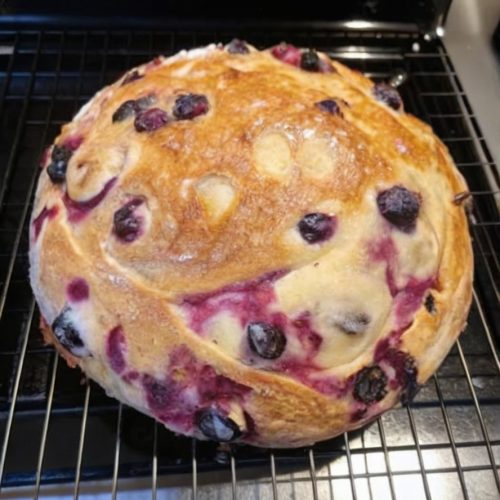

1. Understanding This Bread
This bread is a hybrid between:
- enriched sourdough (because of butter, egg, sugar)
- laminated or filled bread (due to layers of cream cheese and fruit)
- soft breakfast loaf or dessert bread
Unlike a basic sourdough, this dough is:
- softer
- richer
- slower to ferment
- more delicate to handle
Because of the added fats and sugar, gluten develops differently, and fermentation takes longer. That is normal.
2. Ingredient Breakdown (With Purpose)
Flour
- Bread flour gives strength and chew
- A little all-purpose flour softens texture
You can use 100% bread flour, but the loaf will be slightly chewier.
Water
Hydrates the dough. In enriched doughs, hydration feels lower because butter and egg add softness.
Sourdough Starter
Must be:
- active
- bubbly
- recently fed (within 4–6 hours)
If your starter is weak, the bread will be dense.
Sugar
- Feeds fermentation slightly
- Adds sweetness
- Helps browning
Egg
- Adds richness
- Improves structure
- Helps softness
Butter
- Makes crumb soft and tender
- Adds flavor
- Slows gluten formation (which is why it is added later)
Lemon (zest + juice)
- Zest = strong aroma
- Juice = acidity and brightness
Always use fresh lemons for best results.
Blueberries
- Provide moisture and bursts of flavor
- Fresh is ideal, frozen works if handled carefully
Cream Cheese
- Adds creamy contrast
- Slight tang complements sourdough
3. Preparing the Starter
If your starter is not ready:
Mix:
- 50 g starter
- 50 g flour
- 50 g water
Let it sit until:
- doubled in size
- bubbly on top
- smells mildly tangy, not sharp
This usually takes 4–6 hours depending on temperature.
4. Autolyse Stage (Critical for Structure)
Mix:
- flour
- water
Until no dry flour remains.
Rest 30–45 minutes.
Why this matters:
- gluten begins forming naturally
- dough becomes easier to knead
- improves final texture
Do not skip this step unless rushed.
5. Mixing the Dough Properly
Add to the rested dough:
- starter
- sugar
- egg
- lemon zest
- lemon juice
- vanilla
Mix until combined.
Then add salt.
Important:
Salt strengthens gluten but slows fermentation, so it is added after initial mixing.
6. Kneading and Butter Incorporation
Start kneading:
At first:
- dough will be sticky
- uneven
After 5–7 minutes:
- it becomes smoother
Now add butter slowly in small pieces.
Important technique:
- Do NOT dump all butter at once
- Add piece by piece and knead until absorbed
At one stage:
- dough may look broken or greasy
Keep kneading. It will come together again.
Final dough should be:
- smooth
- elastic
- slightly tacky but not overly sticky
You should be able to stretch it thin (windowpane test).
7. Bulk Fermentation (Long and Gentle)
Place dough in a bowl.
Cover and rest 4–6 hours at room temperature.
Stretch and Fold Method
Every 30 minutes (first 2 hours):
- grab one side
- stretch upward
- fold over
Repeat all sides.
Why this is important:
- builds gluten gently
- traps air
- improves structure
Signs fermentation is done:
- dough has risen about 50–75%
- feels airy
- jiggles slightly
Do NOT wait for full doubling (too much for enriched dough).
8. Making the Blueberry Filling (Detailed)
In a saucepan:
- blueberries
- sugar
- cornstarch
- lemon juice
Cook on medium heat.
What happens:
- berries release juice
- cornstarch thickens mixture
You are looking for:
- thick jam-like consistency
- not watery
If too thin:
- cook longer
If too thick:
- add a tiny splash of water
Cool completely before using.
Hot filling will ruin the dough.
9. Cream Cheese Filling (Perfect Texture)
Mix:
- cream cheese
- sugar
- vanilla
- lemon zest
Beat until:
- completely smooth
- no lumps
If too stiff:
- add 1–2 teaspoons milk
Chill before spreading for easier handling.
10. Rolling and Shaping (Critical Stage)
Lightly flour surface.
Roll dough into rectangle:
- about 1 cm thick
Layering
- Spread cream cheese evenly
- Add blueberry filling gently
Do NOT overload:
- too much filling = leakage
Rolling
Roll tightly from one side.
Important:
- keep tension
- avoid trapping air pockets
Seal seam firmly.
Optional Advanced Shaping
For a bakery-style look:
Method 1: Twist loaf
- cut roll lengthwise
- twist both halves
Method 2: Braided loaf
- divide into strands
- braid
Method 3: Swirl loaf
- place directly in pan
11. Final Proof (Very Important)
Place shaped dough in pan.
Cover loosely.
Let rise 2–4 hours.
Signs it is ready:
- visibly puffy
- springs back slowly when pressed
Cold proof option:
Refrigerate overnight (8–12 hours)
Benefits:
- deeper flavor
- easier handling
12. Baking Process (Precise Control)
Preheat oven to 180°C.
Brush top with:
- egg wash or milk
Bake 35–45 minutes.
Watch for:
- golden brown top
- bubbling filling (normal)
If browning too fast:
- cover with foil
Internal temperature:
90–95°C indicates doneness.
13. Cooling (Do Not Rush)
Cool in pan 10–15 minutes.
Then transfer to rack.
Cool completely before slicing.
Why:
- filling sets
- crumb stabilizes
Cutting too early causes:
- collapse
- messy interior
14. Glaze (Optional but Recommended)
Mix:
- powdered sugar
- lemon juice or milk
Drizzle over cooled bread.
15. Texture and Flavor Expectations
Interior:
- soft
- slightly stretchy
- creamy pockets
Flavor:
- tangy
- sweet
- citrusy
- rich
16. Common Mistakes (And Fixes)
Dense bread
Cause:
- weak starter
Fix:
- use active starter
Filling leaking
Cause:
- too much filling
- loose shaping
Fix:
- spread thinner
- roll tighter
Dough too sticky
Cause:
- warm environment
- too much butter too early
Fix:
- chill briefly
Bread too sour
Cause:
- overproofing
Fix:
- shorten fermentation
17. Storage and Shelf Life
Room temperature:
- 1–2 days
Refrigerator:
- up to 5 days
Freezer:
- up to 2 months
Reheating
Warm slices slightly for best texture.
18. Variations
You can adapt this recipe:
- Replace blueberries with raspberries or strawberries
- Add white chocolate chips
- Use orange instead of lemon
- Add streusel topping
19. Final Notes
This bread requires patience more than difficulty. The key skills are:
- understanding dough texture
- controlling fermentation
- careful shaping
Even if it is not perfect the first time, the flavor will still be excellent.